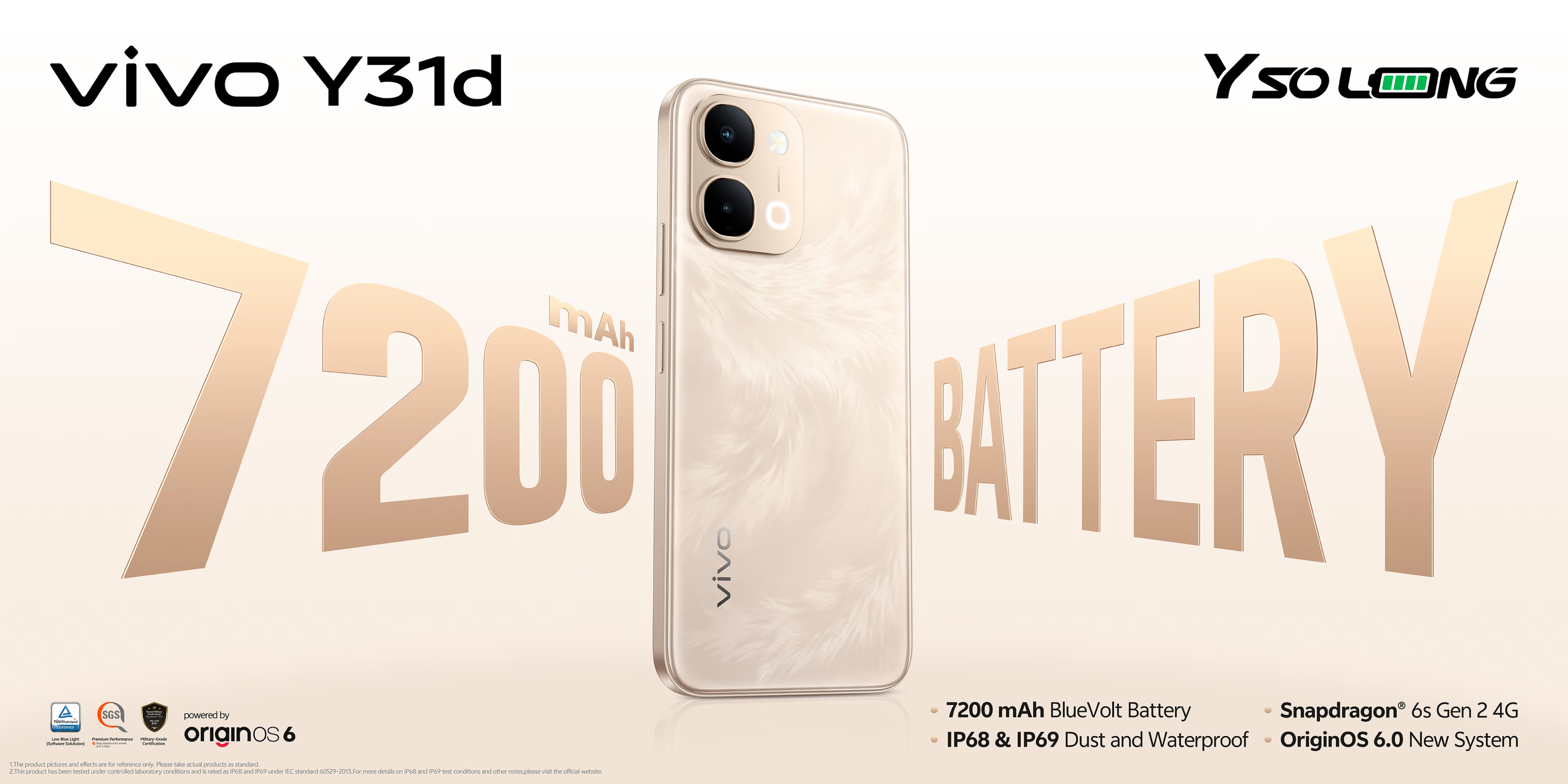
I’ve tested enough “battery monster” phones to know most of them fall apart somewhere else: trash displays, bad software, or flimsy builds. Spending time with the Vivo Y31d, I was hoping this would finally be the one that nails the basics without feeling compromised everywhere else. Instead, it feels like Vivo got halfway there, then stopped caring.
The Y31d absolutely crushes a few fundamentals: endurance, durability, and day-to-day reliability. But the rest of the package is a mix of 2022 hardware dressed up with 2026 buzzwords.

Design and Durability: Overbuilt in a Good Way
Vivo is clearly pitching the Y31d as a workhorse, not a fashion piece, but they didn’t completely phone in the design.
You get two color options: Glow White with a more reflective, gradient-heavy look, and Starlight Grey with a matte, understated finish. The rear camera frame uses metal, which actually does make the phone look and feel a bit more premium than the usual plastic rectangles in this price class.
Dimensions are 166.6 x 78.4 x 8.39 mm (slightly thicker at 8.49 mm on the white variant) and 219 g. For a phone hiding a 7,200mAh pack, that’s surprisingly manageable. It’s not slim by any means, but it’s nowhere near as brick-like as some 6,000mAh phones I’ve handled.
Where things get serious is durability. You’re looking at MIL‑STD‑810H claims, SGS 5-Star durability, and a full stack of ingress ratings: IP68, IP69, and IP69+. On paper, that means resistance to dust, immersion up to 1.5 m for 30 minutes, and even high-pressure water jets and hot water exposure.
Most phones in this bracket can barely manage IP54 or nothing at all. The Y31d is built like someone at Vivo asked, “What if people actually use their phones outdoors?” and then the hardware team went overboard in the right way.

Battery: The One Thing Vivo Nailed
The headline spec is the 7,200mAh battery (some certifications list 7,060mAh, which is likely the rated capacity). Either way, it’s a massive cell, and this is where the Y31d earns its existence.
Vivo’s own numbers claim:
– Up to 68 hours of music playback
– 45 hours of video playback
– 14.5 hours of navigation
– 13.2 hours of MOBA gaming
There’s also a Super Battery Saver mode that allegedly keeps the phone alive for up to 41 hours on just 1% remaining, by aggressively switching off non-essential features. That’s the kind of “your phone just won’t die” behavior people who work in the field, or travel off-grid, actually care about.
Charging is handled by 44W FlashCharge via USB-C (USB 2.0). Vivo claims 1–50% in about 43 minutes, which is reasonable given the battery size. There’s also reverse charging, so the Y31d doubles as a power bank when someone else’s phone gives up first.
Bypass Charging is another practical touch: when gaming while plugged in, it can feed power directly to the system instead of constantly topping up the battery, helping with temperature and long-term health. Vivo even markets the battery as being good for up to around six years of use.
All of this is genuinely impressive. The problem is what you’re giving up to get it.

Display and Audio: Fast Refresh on a Low-Res Panel
On the front, you’re looking at a 6.75-inch IPS LCD with a 120Hz refresh rate and a 720 x ~1,570/1,608 resolution (HD+). Peak brightness hits around 1,250 nits in High Brightness Mode, which is genuinely solid for outdoor visibility.
The good:
– 120Hz on a budget phone means scrolling and animations feel snappy.
– Brightness is high enough that using it under harsh sun isn’t an issue.
– There’s TÜV Rheinland eye protection with low blue light features to reduce eye strain.
The bad:
– In 2026, HD+ on a 6.75-inch panel is hard to justify. Pixels are visible if you’re used to 1080p.
– Competitors in similar price bands are regularly shipping FHD+ panels now.
Vivo did at least modernize the look: you get a punch-hole instead of a dated waterdrop notch. There’s a side-mounted fingerprint scanner on the frame, which is basic but reliable.
Audio is more aggressive. You get stereo speakers (bottom + earpiece) and an “Audio Booster” mode that can push volume up to 400%. Yes, four times. Above 100–200%, quality drops off hard, but for loud environments or navigation instructions on a bike, it’s practical. There’s no 3.5mm jack and no NFC, which is a step backward for anyone used to wired audio or frequent contactless payments.

Performance: 4G-Only and Fine, But Not Ambitious
The Y31d runs on the Snapdragon 6s 4G Gen 2, paired with either 6GB or 8GB of LPDDR4X RAM and 128GB or 256GB UFS 2.2 storage, depending on market. This is an 8-core 6nm part:
– 4x Cortex-A73 at up to 2.9GHz
– 4x Cortex-A53 at 1.9GHz
So yes, we’re still in A73/A53 land in 2026.
In AnTuTu v10, it reportedly lands around 318K. Translation: everyday stuff is fine. Social apps, messaging, video streaming, browsing with multiple tabs — all doable without the phone choking.
For gaming, think “casual and tuned down,” not “maxed out.” Titles like Mobile Legends, Free Fire, and PUBG Mobile are playable, but you’ll want medium or lower graphics for stable frame rates. There’s enough thermal headroom and battery capacity that long sessions don’t instantly murder the battery, especially with Bypass Charging enabled.
But here’s the big compromise: this is a 4G-only chip. Meanwhile, its own siblings, the Y31 and Y31 Pro, ship with Snapdragon 4 Gen 2 and Dimensity 7300 — both 5G-capable and generally more forward-looking.
Vivo basically traded 5G for better battery and durability. That might work for rural users or people in markets where 5G still isn’t widespread or affordable. But in a lot of urban areas, it feels like they’re making you pick yesterday’s network tech for a phone you’re supposed to keep for years.

Cameras: One Decent Sensor, Not Much Else
On the rear, you get two circles but only one real camera:
– 50MP main, f/1.8, PDAF
– Auxiliary/AI sensor (effectively filler)
Daylight shots from the 50MP sensor are described as natural-looking, with acceptable detail and color. Dynamic range isn’t wide, but it’s workable, and Vivo leans on software processing and Night Mode to keep low-light results usable.
The missing piece is obvious: no ultrawide. For a lot of users, ultrawide is more useful than yet another depth or AI sensor. Losing that flexibility just makes the camera system feel cheap, no matter how many megapixels the main sensor has.
Video tops out at 1080p30 on both front and rear. No 4K, no OIS. Expect shaky footage if you shoot while walking, and forget about anything resembling “creator” use.
Front-facing, you get an 8MP selfie camera with a Radiant Selfie mode that tries to compensate in low light. Functional, nothing special.
The IP69+ rating does unlock one rare perk: you can actually shoot underwater within the 1.5 m / 30 minute window. For a low mid-range phone, that’s genuinely unusual and arguably more practical for some people than ultrawide.

Software: New Android, Old Priorities
Where the Y31d surprisingly pulls ahead of its own siblings is software. It runs OriginOS 6 based on Android 16 out of the box. Meanwhile, the Y31 and Y31 Pro launched on Funtouch 15 based on Android 15.
OriginOS 6 brings a few notable tricks:
– Origin Island: an interactive punch-hole “island” that expands for music, notifications, recording, and more.
– Drag & Go: drag-and-drop file handling across already-open apps for quicker multitasking.
– AI tools like AI Transcript Assist for voice-to-text and AI Creation for polishing written content.
On paper, this is a pretty modern setup for a budget-focused Y-series phone. The real question Vivo doesn’t answer here is update commitment. The base is Android 16, which is great, but there’s no stated promise in this material about how many years of OS or security updates you actually get.
Given Vivo’s past record in the lower tiers, I wouldn’t assume Pixel- or Samsung-level longevity.
The Trade-Off Problem: Who Is the Y31d Really For?
Taken piece by piece, the Vivo Y31d looks like a solid, almost boringly sensible phone: gigantic battery, extreme durability, usable performance, modern-enough software, stereo speakers, 120Hz display.
The disappointments stack up when you put it in context:
– 4G-only in 2026, when 5G is standard in this price band in many regions.
– HD+ resolution on a 6.75-inch display, while rivals are doing FHD+.
– No ultrawide camera, 1080p30 video only, no OIS.
– No NFC, no headphone jack.
Meanwhile, its own siblings bring 5G and newer chipsets but with smaller batteries and lower durability ratings. Vivo basically sliced the lineup so you always have to give something up: want long battery and serious IP rating? Lose 5G and display sharpness. Want 5G? Lose some endurance and toughness.
We still don’t have final pricing in key markets like Indonesia, but the target segment is clearly low mid-range. In that space, companies like Xiaomi, Realme, and even Vivo itself have models with sharper screens, 5G, and more flexible camera setups. The Y31d is deliberately narrow: built for people who prioritize “don’t die, don’t break” over everything else.
If your priority list is: battery > durability > price > everything else, the Y31d makes sense. For everyone else, it feels like a phone from a few years ago that happens to be absurdly hard to kill.
Have thoughts on this? Share them in the comments.