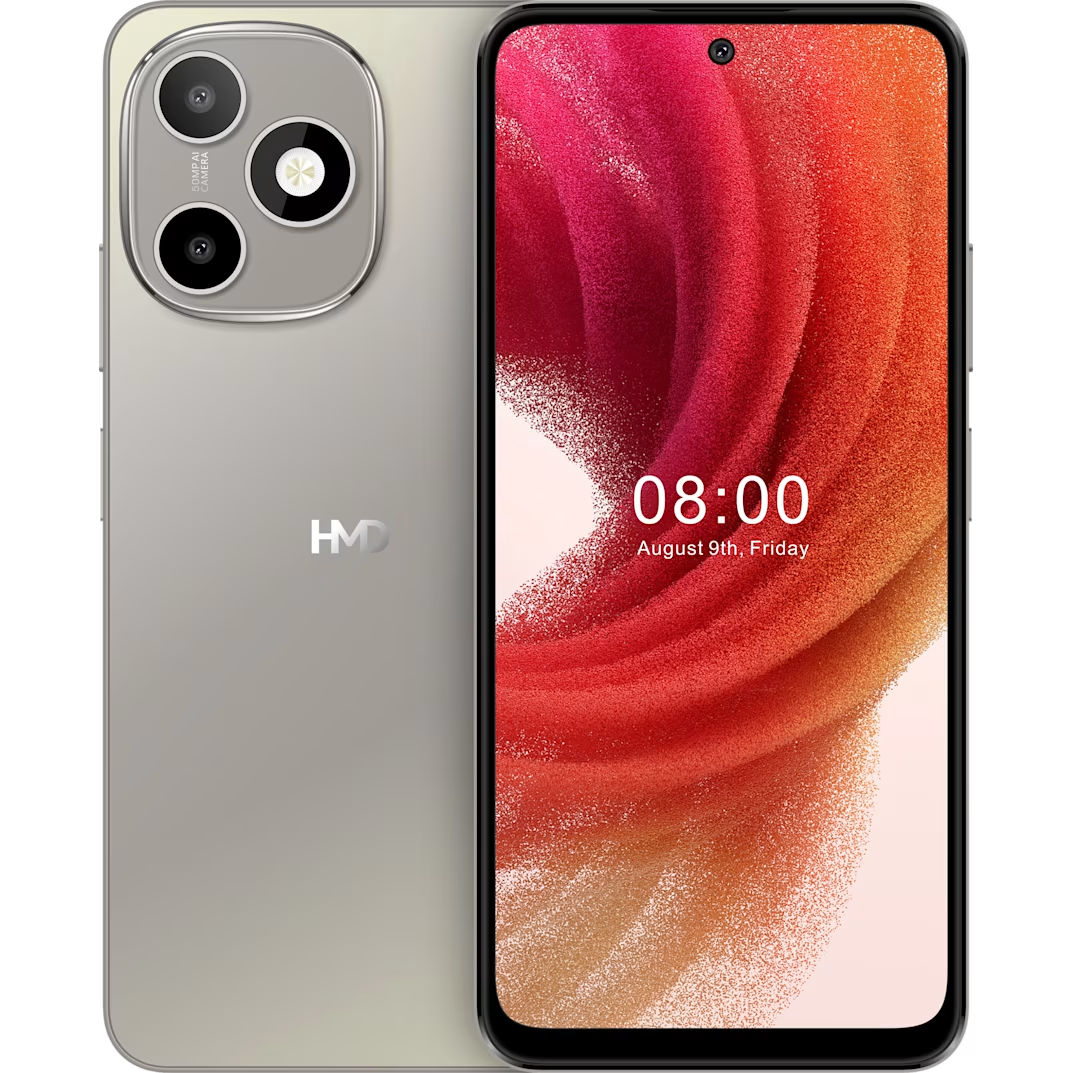
The HMD Luma might quietly become one of the more sensible budget Android phones this year—if HMD doesn’t mess up the pricing.
Not a Lumia Revival, But a Different Budget Play
The name is doing a lot of work here. “Luma” instantly triggers nostalgia for Nokia’s Lumia era, but this isn’t a Windows Phone comeback or a design tribute. HMD is using the branding for an affordable Android device that’s meant to handle the basics: calls, messaging, social media, and light entertainment.
This phone sits in HMD’s growing portfolio alongside the HMD Vibe, but it’s not just a rebadge. The Luma shares a similar positioning as a starter or secondary device, yet HMD has tweaked the core hardware and display to push it slightly in a different direction.
Unisoc T615 Inside: Enough for the Basics, No More
Under the hood, the HMD Luma runs on a Unisoc T615 chipset built on a 12 nm process. The CPU setup combines Cortex-A75 and Cortex-A55 cores—so this isn’t chasing performance charts, but it should be fine for messaging apps, web browsing, YouTube, and casual social scrolling.
HMD pairs the chip with 4 GB of RAM, which is the bare minimum for Android in 2024 if you want to avoid constant reloads. For storage, users get either 128 GB or 256 GB, with a microSD slot for expansion. That combo makes more sense than stuffing in a faster chip and then crippling it with 64 GB storage.
The comparison point here is HMD’s own Vibe, which uses a Qualcomm Snapdragon 680 built on a more efficient 6 nm process. On paper, that SoC should be a bit better on power and thermals. Both are 4G-only platforms, though, so no model here is targeting 5G users.
120Hz LCD on a 720p Panel: Smooth but Soft
The display is where HMD is clearly trying to catch attention. The Luma has a 6.7-inch LCD with a 720 x 1,604 resolution and a 120 Hz refresh rate. So you get a big panel with high refresh, but only HD-level sharpness.
For a budget phone, a 120 Hz screen is still a nice quality-of-life upgrade. Scrolling through feeds and basic UI navigation should feel smoother than on 60 Hz rivals. But don’t expect flagship-level clarity; 720p at 6.7 inches means text and UI elements won’t look as crisp as on a 1080p panel.
Interestingly, this is a small spec win over the HMD Vibe, which offers a lower refresh rate. If you care more about perceived smoothness than pixel density, the Luma’s display trade-off might actually work in your favor.
50MP Main Camera and an 8MP Selfie: Familiar Formula
On the camera side, HMD isn’t reinventing anything, but it’s following the current budget template. The Luma carries a 50 MP main camera, matching the resolution of the HMD Vibe 5G’s primary sensor.
There’s also an 8 MP front camera for selfies and video calls. No ultra-wide or telephoto is mentioned, so you’re likely getting a single main shooter doing most of the work, plus whatever secondary depth or macro sensor may be tucked in that isn’t specified.
How good that 50 MP camera is will depend entirely on HMD’s tuning and processing, which we don’t have details on yet. Still, a decently tuned 50 MP sensor can deliver usable daylight shots and acceptable social-ready photos, which is enough for the Luma’s target audience.
5,000mAh Battery and 18W Charging: The Safe Play
Powering all this is a 5,000 mAh battery with 18 W wired charging over USB-C 2.0. That’s the current baseline spec for a sensible budget phone: big battery, modest charging speed, modern port.
Combined with a 12 nm Unisoc chip and a 720p LCD, the Luma should deliver solid endurance, especially for lighter users. Heavy video streaming and gaming will stress that CPU/GPU combo, but this phone clearly isn’t targeting that crowd.
18 W charging won’t impress anyone used to 60 W+ on Chinese mid-rangers, but for the segment HMD seems to be aiming at, it’s adequate. This is very much a “charge once a day, forget about it” sort of setup.
Old-School Features: Headphone Jack and FM Radio Live On
What might actually sell the Luma in emerging markets isn’t the 120 Hz display—it’s the old-school hardware HMD decided to keep.
There’s a 3.5 mm headphone jack, which still matters in regions where wired earphones are common and Bluetooth earbuds are a luxury. FM radio is also on board, still a big deal where mobile data is expensive or unreliable.
You also get stereo speakers and Bluetooth 5.0 support. Again, nothing flashy, but for watching videos, listening to radio or music without external speakers, and pairing budget wireless earphones, this checks the right boxes.
Regional Launch and the Big Unknown: Price
So far, the HMD Luma has shown up on HMD’s official sites for Nigeria and Ghana, in two colors: Titanium and Blue. That lines up with HMD’s broader strategy of leaning into emerging markets with affordable, practical Android devices.
The catch: there’s still no official price. A teaser on Instagram suggests the launch is happening soon, but without a number attached, it’s impossible to judge how competitive this thing really is.
Price will decide whether the compromises—Unisoc chip, 720p panel, basic cameras—are reasonable. If HMD pushes it too high, it’ll be hard to justify over rival budget phones that may offer sharper screens or better-known chipsets.
Cautious Verdict: Sensible Specs, Execution TBD
On paper, the HMD Luma looks like a grounded, no-nonsense budget Android phone: 120 Hz LCD, 50 MP main camera, 5,000 mAh battery, 18 W charging, headphone jack, FM radio, and stereo speakers. The Unisoc T615 and 4 GB RAM setup won’t wow enthusiasts, but it’s aligned with the device’s “basic needs first” positioning.
The cautious optimism comes from how focused this spec sheet is for its likely audience: social media, messaging, and long battery life in markets like Nigeria and Ghana, where those old-school features still matter.
The unanswered questions are price and software experience. If HMD keeps the price genuinely low and delivers a clean, stable Android build, the Luma could be a very sensible pick for budget buyers who care more about practicality than benchmarks.
Until we see real-world performance, camera samples, and the final price tag, this stays in the “promising on paper” category—not an instant buy, but worth keeping an eye on.
Have thoughts on this? Share them in the comments.