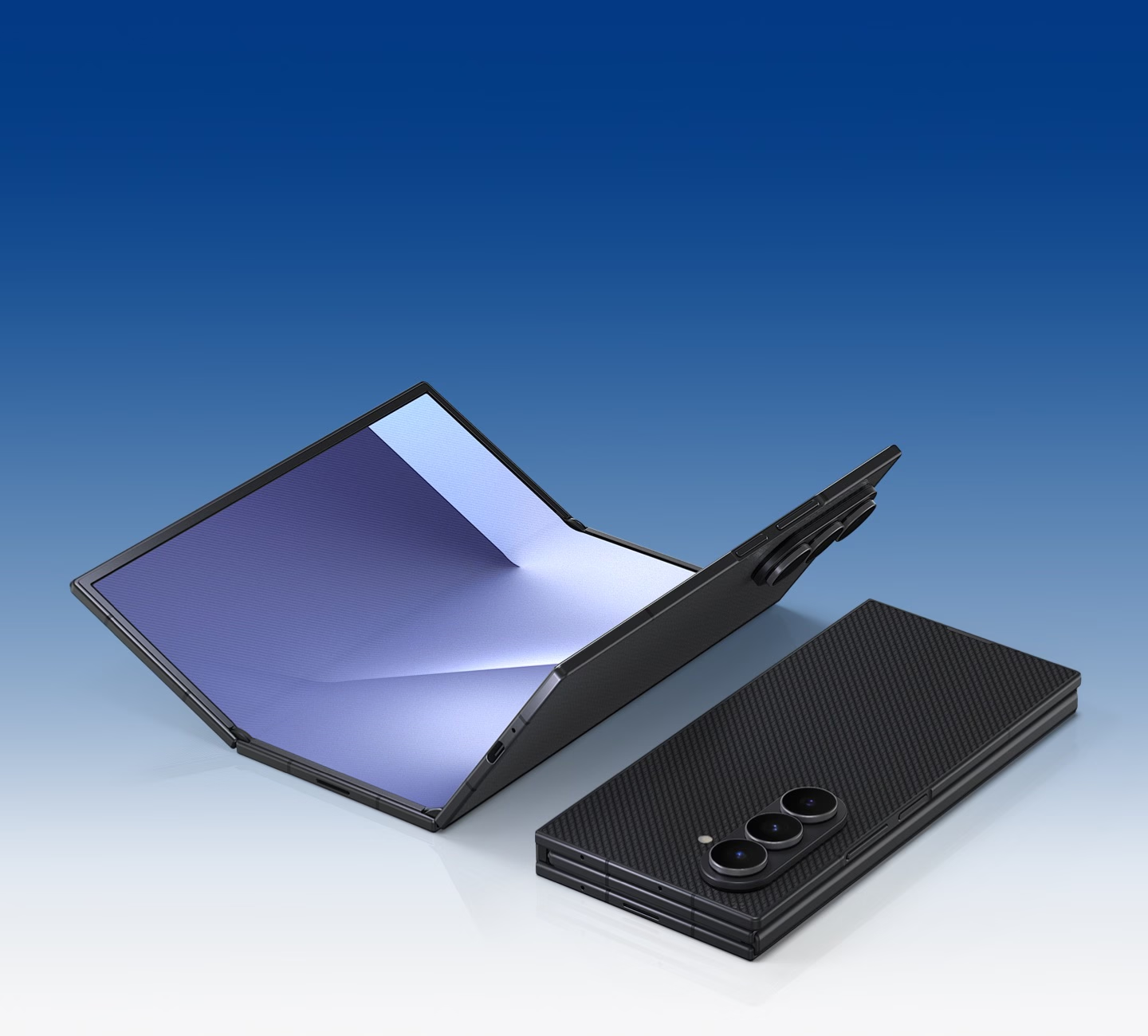
The foldable market keeps pretending it’s matured, but then a single mod video comes along and makes one of Samsung’s most ambitious devices look outdated overnight.
A YouTube channel took Honor’s silicon-carbon (Si/C) battery tech from the Magic V6 and used it to boost the Samsung Galaxy Z TriFold’s battery capacity by an absurd 71%. That’s not a small generational bump. That’s the difference between “maybe gets through the day” and “why did the OEM ship it like this?”
Samsung’s TriFold Ambition, Undercut by a 5,600 mAh Battery
Samsung announced the Galaxy Z TriFold in December with a 5,600 mAh battery. For a device that literally folds in three, that sounds respectable until you compare it to both regular slabs and other foldables.
We’re already seeing non-folding Android phones push 6,000 mAh and beyond. Some foldables have crossed the 6,000 mAh line as well. So for a trifold—more screens, more hinges, more potential for power drain—to come in under that bar raises questions.
The obvious missing piece: silicon-carbon batteries. Samsung is still avoiding them in 2026, sticking to safer, older chemistry while competitors like Honor are moving on.
Honor’s Si/C Pack Turns a 5,600 mAh TriFold Into a 9,600 mAh Beast
Honor’s Magic V6 ships with a 6,600 mAh Si/C battery. That alone puts it ahead of Samsung’s 5,600 mAh TriFold pack on paper. But the real headline comes from what the modders at the Strange Parts YouTube channel did next.
They took Honor’s Si/C batteries and swapped them into the Galaxy Z TriFold. After the operation, the TriFold’s total capacity jumped from 5,600 mAh to 9,600 mAh—about a 71% increase. Same device, same physical concept, just different cells.
You’re not looking at a prototype lab demo here. This is a retail Samsung foldable, upgraded using battery tech from a retail Honor foldable. No magic, no wishful thinking—just a very public reminder that Samsung chose not to ship this kind of capacity.
What Silicon-Carbon Batteries Change for Foldables
Silicon-carbon batteries let manufacturers pack higher capacity into a similar physical volume compared to traditional lithium-ion designs. That’s critical in foldables, where internal space is eaten by hinges, additional display layers, and structural reinforcements.
Honor’s use of a 6,600 mAh Si/C battery in the Magic V6 shows they’re willing to push density where it matters: devices that are already fighting for every cubic millimeter. The fact that those same Si/C cells can be transplanted into a competing trifold and push it to 9,600 mAh is basically a live-action benchmark of how far behind Samsung’s conservative chemistry choices really are.
Samsung isn’t incapable of this. The company makes its own batteries and has the R&D budget to move faster. But for the Galaxy Z TriFold, it decided to ship with older tech and lower capacity, even as the rest of the industry experiments harder.
This Mod Is Impressive—and Kind of Embarrassing
On one hand, what Strange Parts pulled off here is legitimately cool engineering. A 71% capacity jump is massive on any device, let alone a complex trifold where thermal behavior, fit, and safety are all harder to manage.
On the other hand, it makes Samsung’s official product strategy look timid. Consumers are being asked to pay premium foldable prices while hobbyist modders demonstrate that the hardware has room for much more ambitious battery choices.
Even if this exact 9,600 mAh configuration wouldn’t pass Samsung’s internal safety, weight, or thickness standards, it still proves there was headroom. Samsung didn’t bump into a physics wall. It just chose not to get closer to it.
What This Says About Foldables in 2026
We’re in a weird place where foldable designs keep getting more complex—dual folds, larger internal panels, more demanding multitasking—while battery strategies from some big players still feel like 2020.
The Galaxy Z TriFold should have been Samsung’s flex: a showcase that folding three ways doesn’t have to mean compromising basics like endurance. Instead, it ships with 5,600 mAh while a YouTube mod pushes the same chassis to 9,600 mAh using off-the-shelf Si/C tech from a rival.
If anything, this mod highlights where the pressure needs to go next. Foldable enthusiasts don’t just want more hinges and clever software. They want the fundamentals taken seriously—battery first, gimmicks second.
Honor Steps Forward While Samsung Plays It Safe
Honor’s Magic V6 is still going through formal reviews, but one thing is already clear from its spec sheet: the company is willing to bet on Si/C batteries in a mainstream foldable. A 6,600 mAh pack on a foldable in 2026 isn’t wild wishful thinking—it’s a shipping product.
That’s the contrast. Honor is pushing chemistry and capacity. Samsung is pushing form factor complexity while holding back on the one upgrade that directly changes how long you can actually use the device.
Nobody’s saying every foldable should suddenly ship with nearly 10,000 mAh. But a 5,600 mAh trifold in a world where a mod can reach 9,600 mAh using a competitor’s cells? That’s not innovation. That’s leaving performance on the table and hoping users don’t notice.
Have thoughts on this? Share them in the comments.